
June 13, 2026
For many commercial property owners, the parking lot is one of the most valuable—and most overlooked—assets on the property.
Whether you manage a shopping center in Melbourne, a medical facility in Rockledge, an apartment community in Palm Bay, an office park in Viera, a warehouse in Cocoa, or a commercial property anywhere throughout Brevard County, your pavement is working every day.
Customers drive across it.
Employees park on it.
Delivery trucks use it.
Tenants rely on it.
Visitors form opinions about your property because of it.
Yet many property owners don't think about their asphalt until major problems appear.
Unfortunately, by the time potholes, extensive cracking, drainage failures, and pavement deterioration become obvious, repair costs are often much higher than they need to be.
The most successful property owners take a different approach.
Instead of reacting to problems, they follow a proactive asphalt maintenance strategy designed to extend pavement life, improve safety, reduce liability, and lower long-term ownership costs.
This guide outlines the same maintenance principles used by experienced property managers, facility directors, HOA boards, and commercial real estate owners throughout Brevard County.
Think of your parking lot like the roof on your building.
You wouldn't wait for water to pour through the ceiling before addressing roof maintenance.
The same concept applies to asphalt.
Parking lots naturally deteriorate over time.
The goal isn't to eliminate maintenance costs entirely.
The goal is to slow deterioration, preserve your investment, and avoid expensive reconstruction projects whenever possible.
A properly maintained parking lot can:
The difference between a parking lot that lasts 15 years and one that lasts 25 years often comes down to maintenance.
Before discussing maintenance, it's important to understand what causes asphalt failure.
Many property owners assume potholes are the problem.
In reality, potholes are usually the result of a much larger issue.
Most pavement failures begin with:
Florida's UV exposure breaks down asphalt binders.
Water enters cracks and weakens the pavement structure.
Vehicles create repeated loading forces.
Standing water accelerates deterioration.
Small problems become major repairs.
Understanding these causes helps explain why preventative maintenance works.
The most important item on any asphalt maintenance checklist is regular inspections.
Many property owners only evaluate their pavement when a complaint arises.
By then, deterioration may already be advanced.
Professional inspections should be performed:
Regular inspections help identify:
Small cracks often indicate early-stage deterioration.
Standing water should never be ignored.
Fading pavement often signals aging asphalt.
Early detection allows for smaller repairs.
Parking lot edges frequently deteriorate first.
Routine inspections are one of the most cost-effective maintenance tools available.
If there is one service that consistently delivers exceptional value, it is crack sealing.
Water is asphalt's greatest enemy.
Once water enters the pavement structure, deterioration often accelerates rapidly.
Small cracks may seem harmless.
However, they provide direct access to the base layer beneath the asphalt.
When moisture reaches the base, problems begin developing below the surface.
Crack sealing helps:
Many expensive pavement failures begin as cracks that could have been repaired for a fraction of the eventual cost.
Potholes are more than an inconvenience.
They often indicate that deterioration has already progressed below the pavement surface.
Ignoring potholes can lead to:
Prompt repairs help prevent surrounding pavement from deteriorating further.
For shopping centers, apartment communities, schools, churches, and medical facilities, pothole repairs should be considered a priority.
One of the most overlooked aspects of pavement maintenance is drainage.
Parking lots are designed to move water efficiently away from the pavement surface.
When drainage systems stop functioning properly, deterioration often accelerates.
Property owners should routinely inspect:
Ensure drains remain free of debris.
Verify water flows properly.
Monitor standing water locations.
Settlement may alter drainage patterns.
Maintain proper stormwater management.
If water remains on pavement for more than a day after rainfall, further evaluation is often warranted.
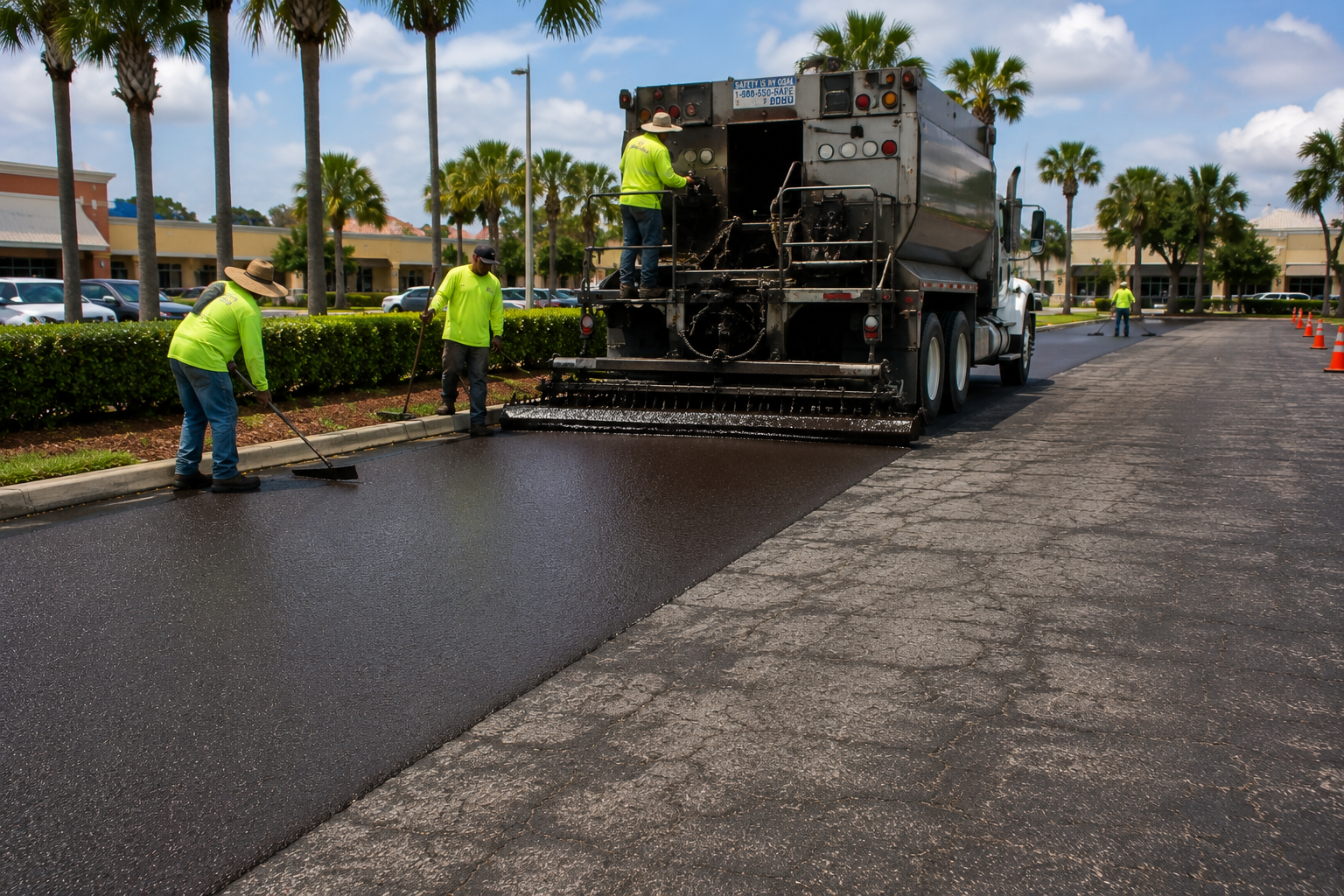
Many commercial property owners view sealcoating primarily as a cosmetic service.
While it certainly improves appearance, its value goes much deeper.
Sealcoating helps protect asphalt from:
Florida's intense sunlight makes sealcoating particularly valuable.
Throughout Melbourne, Palm Bay, Cocoa, Titusville, Viera, Merritt Island, and Rockledge, UV damage remains one of the leading causes of pavement aging.
Sealcoating acts as a protective barrier that helps slow this process.
Fresh pavement markings do more than improve appearance.
They contribute directly to:
Drivers navigate more effectively.
Directional markings improve circulation.
Accessible spaces remain clearly visible.
Clearly marked stalls maximize parking capacity.
Well-striped lots create positive first impressions.
Many commercial properties benefit from restriping every few years depending on traffic volume and wear.
Even with excellent maintenance, every parking lot eventually requires larger rehabilitation projects.
The most successful property owners plan years in advance.
Potential future projects may include:
Installing a new surface layer.
Removing worn asphalt and replacing it.
Correcting underlying water issues.
Reserved for severe structural failures.
Long-term planning helps avoid emergency expenditures and budget surprises.
By the time major deterioration appears, repairs are often more expensive.
Small cracks frequently become major failures.
UV damage never stops.
Standing water accelerates deterioration.
Large projects should never come as a surprise.
Maintenance is actually an investment in preserving a valuable asset.
Protect customer experiences and curb appeal.
Maintain safe, accessible parking areas.
Improve tenant satisfaction.
Support heavy traffic demands.
Protect common area infrastructure.
Provide safe access for members and guests.
Improve safety for students, staff, and visitors.
Extend the life of private roads and parking areas.
Many property owners focus on the cost of maintenance.
Experienced property managers focus on the cost of neglect.
A proactive maintenance strategy often delivers:
The goal is not spending more money.
The goal is spending smarter money.
Commercial asphalt surfaces represent a substantial investment.
Like roofing systems, HVAC equipment, elevators, and building exteriors, they require ongoing maintenance to perform at their best.
Whether you own a shopping center in Melbourne, manage an HOA in Viera, oversee a medical facility in Rockledge, operate a warehouse in Cocoa, or manage an apartment community in Palm Bay, a proactive asphalt maintenance plan can significantly reduce long-term costs while improving safety and property appearance.
The most successful property owners don't wait for potholes, drainage failures, and major cracking to dictate their maintenance schedule.
They stay ahead of deterioration.
By conducting regular inspections, sealing cracks, repairing potholes, maintaining drainage, scheduling sealcoating, refreshing striping, and planning for future improvements, you can maximize the lifespan of your pavement and protect your investment for years to come.
321Pave proudly provides commercial asphalt maintenance, sealcoating, crack sealing, pothole repair, parking lot striping, resurfacing, and pavement management services throughout Melbourne, Palm Bay, Viera, Rockledge, Cocoa, Merritt Island, Titusville, Satellite Beach, Indialantic, Melbourne Beach, Cape Canaveral, Cocoa Beach, West Melbourne, and all of Brevard County.
If you’re looking for a reliable asphalt paving company in Orlando & Brevard County, FL, our team is ready to help. Whether it’s repairs, resurfacing, or a full paving project, we’ll evaluate your site and recommend the most practical solution.
