
June 22, 2026
One of the most common questions property owners ask is:
"Do I really need to replace my parking lot, or can it be resurfaced?"
It's a fair question.
For many commercial property owners, HOA boards, churches, schools, medical facilities, apartment communities, industrial parks, and retail centers throughout Brevard County, asphalt pavement represents one of the largest infrastructure investments on the property.
When deterioration begins appearing, many owners assume complete reconstruction is inevitable.
In reality, that often isn't the case.
Many parking lots throughout Melbourne, Palm Bay, Viera, Rockledge, Cocoa, Titusville, Merritt Island, Satellite Beach, Indialantic, Cocoa Beach, Cape Canaveral, Melbourne Beach, West Melbourne, Indian Harbour Beach, and surrounding communities can often be restored through asphalt resurfacing or overlay projects.
When performed at the right time, resurfacing can dramatically extend pavement life while costing significantly less than full replacement.
Understanding when resurfacing makes sense—and when it doesn't—is one of the most important decisions a property owner can make.
Asphalt resurfacing is the process of installing a new layer of asphalt over an existing pavement surface.
Rather than removing and replacing the entire parking lot, resurfacing preserves much of the existing structure while restoring the surface.
This process is sometimes referred to as:
The objective is simple:
Restore appearance, improve performance, extend pavement life, and postpone the need for costly reconstruction.
Before discussing resurfacing, it's important to understand why asphalt fails.
Brevard County presents unique challenges for pavement.
Throughout the year, asphalt is exposed to:
Florida sunlight gradually oxidizes asphalt binders.
Water infiltration remains the leading cause of pavement failure.
Asphalt surface temperatures often exceed 140 degrees.
Constant moisture contributes to long-term deterioration.
Heavy rainfall accelerates pavement damage.
Vehicles place repeated stress on aging pavement surfaces.
Over time these forces begin weakening the asphalt.
The question becomes whether the pavement can still be preserved.
Not every parking lot qualifies for an overlay.
A successful resurfacing project depends largely on the condition of the pavement underneath.
The existing pavement must still provide a reasonably stable foundation.
Good resurfacing candidates often exhibit:
The pavement has faded from black to gray.
Cracks are present but not widespread structural failures.
Traffic has worn down the top layer.
Localized failures can often be repaired before resurfacing.
The parking lot looks tired but remains structurally sound.
These properties frequently benefit from asphalt overlays.
Sometimes property owners try to overlay pavement that has already reached the end of its life.
Unfortunately, asphalt overlays cannot solve every problem.
Resurfacing may not be appropriate when:
This often indicates structural failure.
The support system beneath the asphalt has deteriorated.
Water problems must be corrected first.
Structural issues generally require more extensive repairs.
The pavement may require reconstruction.
This is why a professional pavement evaluation is essential before proceeding.
Property owners frequently hear these terms used interchangeably.
They are not the same.
A new asphalt layer is installed directly over the existing surface.
Best for pavement with relatively minor deterioration.
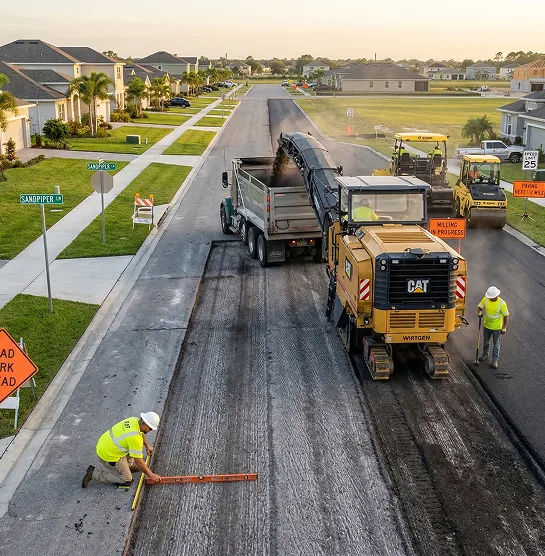
The upper layer of deteriorated asphalt is removed through milling.
New asphalt is then installed.
Mill and pave often produces superior results because surface irregularities are removed before paving.
The existing pavement structure is removed and rebuilt.
Typically reserved for severe structural failures.
This is generally the most expensive option.
For the right pavement, resurfacing offers significant benefits.
One of the biggest advantages is affordability.
Resurfacing typically costs substantially less than complete replacement.
A fresh asphalt surface dramatically improves curb appeal.
For shopping centers, office parks, apartment communities, churches, and medical facilities, this visual improvement is significant.
Resurfacing can add years of useful service life to existing pavement.
Smooth pavement improves:
Eliminating potholes and uneven surfaces helps reduce risk.
Parking lots create first impressions.
Fresh pavement reflects positively on the entire property.
Many property owners have never been through a resurfacing project.
The process generally includes several stages.
The existing parking lot is evaluated.
Contractors determine whether resurfacing is appropriate.
Localized failures are repaired.
Common repairs include:
The existing pavement must be prepared properly.
Preparation often determines long-term performance.
For mill and pave projects, deteriorated asphalt is removed.
New asphalt is installed and compacted.
Parking lot striping is restored.
This often includes:
Many types of properties throughout Brevard County utilize asphalt overlays.
Retail centers rely heavily on appearance and accessibility.
Patients appreciate safe, smooth parking surfaces.
Private roads often benefit from resurfacing.
Residents expect attractive and functional parking areas.
Well-maintained parking lots create positive impressions for visitors.
Parking lots, bus loops, and drop-off lanes require durable pavement.
Heavy traffic areas often benefit from rehabilitation.
Professional appearance supports tenant retention.
One of the biggest mistakes property owners make is waiting too long.
Asphalt follows a predictable deterioration curve.
The earlier resurfacing occurs, the more value property owners typically receive.
Waiting until pavement reaches severe structural failure often eliminates resurfacing as an option.
This leaves reconstruction as the only practical solution.
In many cases, resurfacing performed at the right time can save tens of thousands of dollars over the life of a parking lot.
Performance varies based on traffic, drainage, maintenance, and pavement condition.
Yes. In most cases resurfacing costs significantly less than reconstruction.
Absolutely. Proper repairs are an important part of the process.
Minor improvements may occur, but significant drainage problems generally require corrective work.
Dramatically. Fresh asphalt provides one of the most noticeable exterior improvements available.
Many property owners mistakenly believe that aging asphalt automatically requires complete replacement.
In reality, numerous parking lots throughout Brevard County can be restored through professional resurfacing or overlay projects.
The key is acting before structural deterioration becomes severe.
Whether you manage a shopping center in Melbourne, a medical facility in Rockledge, an HOA community in Viera, an apartment complex in Palm Bay, a church in Cocoa, a school in Titusville, or a commercial property anywhere throughout Brevard County, asphalt resurfacing may provide a cost-effective way to extend pavement life and improve property appearance.
At 321Pave, we help commercial property owners, HOA boards, schools, churches, retail centers, medical facilities, municipalities, and industrial property managers evaluate pavement conditions and determine the most cost-effective long-term solutions.
If you’re looking for a reliable asphalt paving company in Orlando & Brevard County, FL, our team is ready to help. Whether it’s repairs, resurfacing, or a full paving project, we’ll evaluate your site and recommend the most practical solution.
