

June 13, 2026
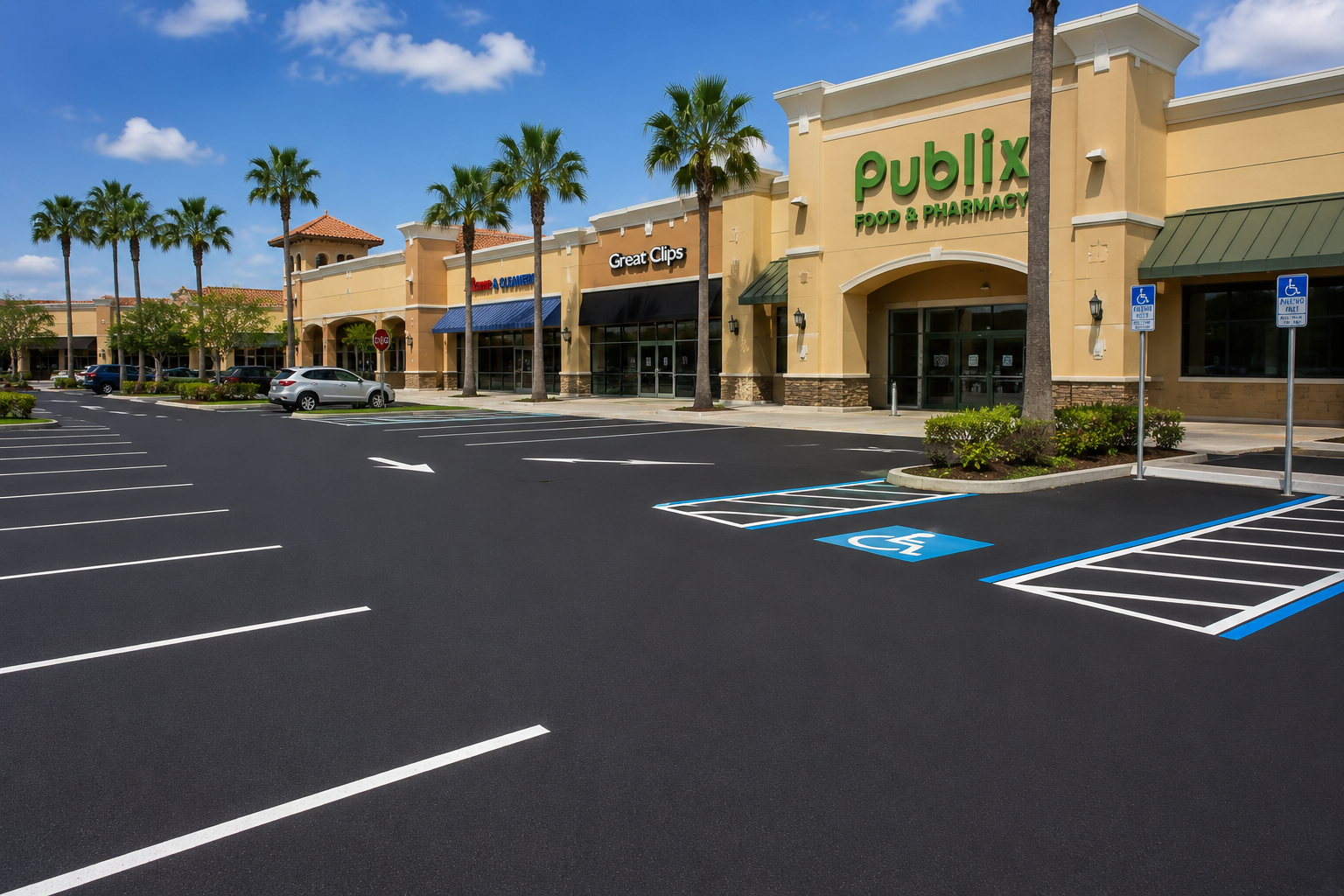
A freshly paved or sealcoated parking lot can completely transform the appearance of a property.
The asphalt looks rich and black. The surface appears clean and well-maintained. Customers immediately notice the difference. Tenants appreciate the improved appearance. Property managers feel confident knowing they are protecting one of the property's most valuable assets.
But there is one final step that often determines whether a parking lot truly looks finished:
Parking lot striping.
Surprisingly, one of the most common questions property owners throughout Brevard County ask is:
"Should the striping be done before or after sealcoating?"
The answer is straightforward.
Parking lot striping should always be completed after sealcoating has been applied and properly cured.
While this may sound like a simple scheduling detail, the timing of striping plays a significant role in the appearance, functionality, safety, and long-term performance of a parking lot.
For shopping centers in Melbourne, medical facilities in Rockledge, apartment communities in Palm Bay, HOA properties in Viera, churches in Titusville, office parks in Cocoa, and commercial properties throughout Brevard County, understanding the relationship between sealcoating and striping can help maximize the return on every pavement maintenance investment.
Many property owners view striping as little more than painted lines.
In reality, parking lot striping serves several critical purposes.
A properly striped parking lot helps:
Without clearly visible markings, even the best-maintained parking lot can become difficult to navigate.
Visitors rely on pavement markings far more than most people realize.
Every parking stall, directional arrow, stop bar, crosswalk, fire lane, loading zone, and ADA space contributes to the overall functionality of the property.
When markings fade, problems begin appearing.
Florida's climate is tough on pavement markings.
Throughout Brevard County, parking lot striping is exposed to:
Over time, painted markings gradually fade.
This fading often occurs so slowly that property owners may not notice it.
Customers, however, often do.
Common issues associated with faded striping include:
Drivers struggle to identify parking spaces and traffic patterns.
Confusion increases when directional markings become difficult to see.
Accessible parking spaces must remain clearly visible.
Faded lines often lead to inconsistent parking patterns.
A worn parking lot can make an otherwise attractive property appear neglected.
This is why restriping is such an important part of pavement maintenance.
To understand why striping follows sealcoating, it helps to understand what sealcoating actually does.
Sealcoating is a protective treatment applied to the asphalt surface.
It helps shield pavement from:
The application creates a uniform protective layer across the asphalt surface.
If striping is installed first, that protective coating would simply cover the markings.
The lines would effectively disappear beneath the sealcoat.
The result would be wasted labor, wasted materials, and additional costs.
For this reason, professional pavement contractors always perform sealcoating first.
Many property owners have never observed a sealcoating project from start to finish.
The process generally involves:
Debris, dirt, and contaminants are removed.
Existing cracks are treated before sealcoating.
The surface is prepared to receive the coating.
Protective material is applied evenly across the pavement.
The sealcoat must properly cure before traffic or striping occurs.
New pavement markings are installed.
Each step plays an important role in the finished product.
Skipping or rushing any phase can impact results.
One of the biggest mistakes in parking lot maintenance is applying striping too soon.
Fresh sealcoat requires time to cure.
Applying pavement markings before the surface is ready may lead to:
Allowing adequate cure time helps ensure long-lasting results.
This is why professional contractors carefully schedule striping after the sealcoat has fully set.
Few maintenance projects provide a more dramatic visual improvement than combining sealcoating and restriping.
The difference can be remarkable.
Before:
After:
For commercial properties, this transformation often creates an immediate positive impression.
Many commercial property owners choose to combine sealcoating and restriping into a single project.
This approach offers several advantages.
Rather than scheduling separate projects months apart, work can often be coordinated together.
This minimizes inconvenience for:
Fresh striping looks best against newly sealcoated asphalt.
The contrast creates maximum visibility.
Combining services often simplifies maintenance planning.
A coordinated project creates a finished appearance across the entire property.
One of the most important reasons to refresh striping after sealcoating is ADA compliance.
Accessible parking spaces require:
Over time, these markings fade.
When restriping occurs, property owners have an opportunity to evaluate whether existing markings remain compliant.
For shopping centers, churches, schools, medical facilities, office parks, and apartment communities throughout Brevard County, maintaining accessible parking areas is an important part of property management.
Nearly every commercial property benefits from these services.
Enhance curb appeal and customer experience.
Improve patient safety and navigation.
Create welcoming environments for visitors.
Improve traffic flow and pedestrian safety.
Maintain community appearance and infrastructure.
Increase resident satisfaction.
Support professional property image.
Improve organization and traffic control.
Parking lot striping is often viewed as an appearance upgrade.
In reality, it plays a major role in safety.
Visible markings help drivers identify:
Without clear markings, confusion increases.
Proper striping helps create safer environments for both vehicles and pedestrians.
There is no universal answer.
The ideal schedule depends on factors such as:
High-traffic commercial properties may require more frequent restriping than lower-traffic facilities.
Routine inspections help determine when visibility has diminished enough to justify repainting.
Many property owners see sealcoating and striping as cosmetic improvements.
The most successful property managers view them differently.
They view them as asset preservation.
Parking lots represent a significant investment.
Like roofs, HVAC systems, landscaping, and building exteriors, pavement requires ongoing care.
Sealcoating protects the asphalt.
Striping protects the functionality of the parking lot.
Together, they help preserve the property's value and appearance.
Without question, the best time to restripe is immediately after sealcoating has properly cured.
This timing allows property owners to:
Most importantly, it ensures the parking lot receives the full benefit of both services.
Property owners often spend thousands of dollars protecting their pavement through sealcoating.
Failing to complete restriping afterward leaves the project unfinished.
The combination of sealcoating and fresh striping delivers one of the highest visual returns available in commercial property maintenance.
Whether you manage a shopping center in Melbourne, an HOA in Viera, a church in Palm Bay, a medical facility in Rockledge, a school in Titusville, or an office complex in Cocoa, proper timing between sealcoating and striping helps maximize both appearance and performance.
At 321Pave, we help property owners throughout Melbourne, Palm Bay, Viera, Rockledge, Cocoa, Merritt Island, Titusville, Satellite Beach, Indialantic, Melbourne Beach, Cape Canaveral, Cocoa Beach, and all of Brevard County develop pavement maintenance plans that improve safety, appearance, and long-term pavement performance.
If you’re looking for a reliable asphalt paving company in Orlando & Brevard County, FL, our team is ready to help. Whether it’s repairs, resurfacing, or a full paving project, we’ll evaluate your site and recommend the most practical solution.
